
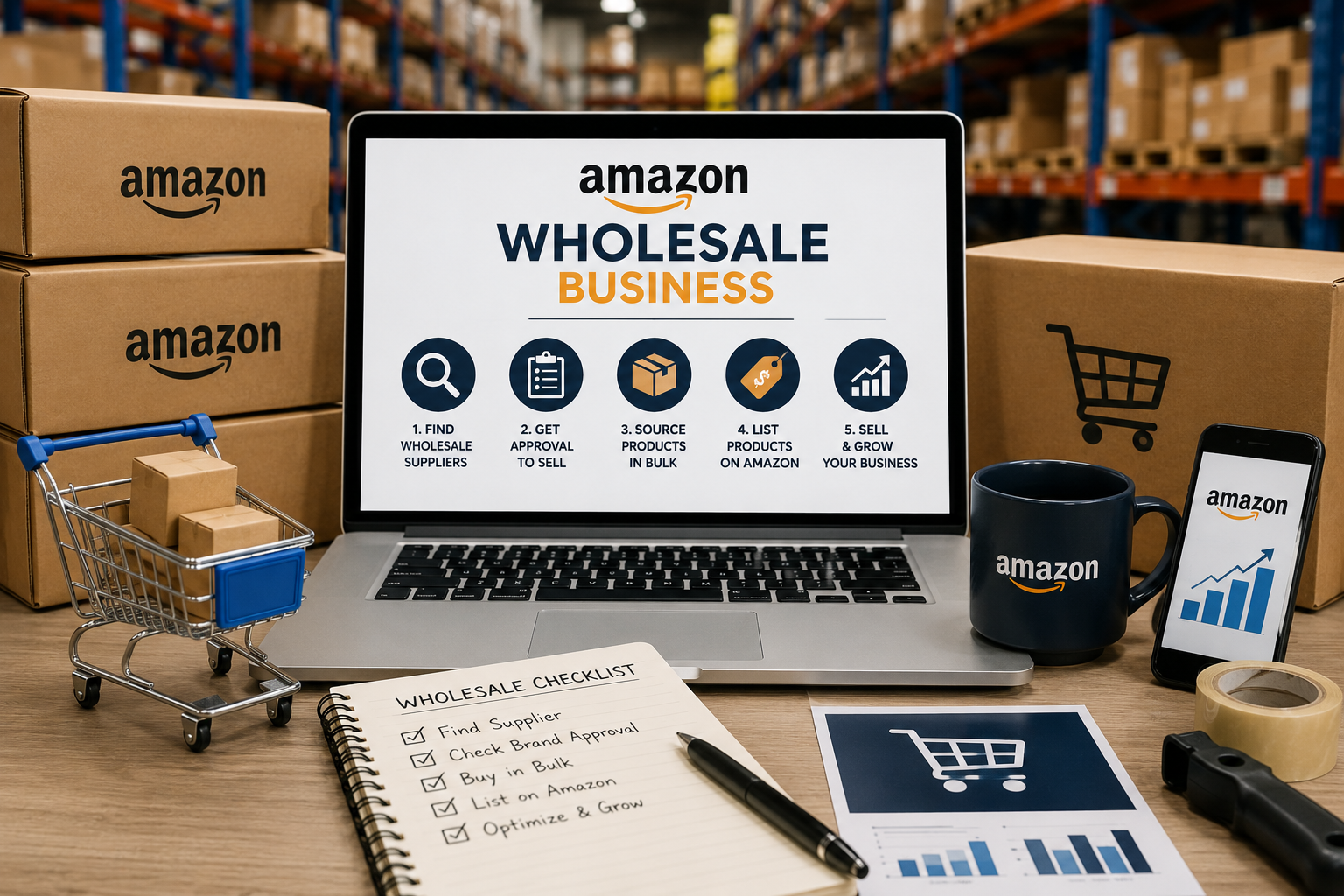
Wholesale is the least glamorous Amazon model and, for a lot of sellers, the most durable. You are not inventing a brand or gambling on a trend. You are buying products people already search for and competing on availability and fulfilment.
It is also the model most likely to stall at step three, when someone has a supplier list but no approved accounts. Here is the sequence that actually works.
How to Wholesale on Amazon: The Model in One Paragraph
You buy branded products in bulk from an authorized distributor at wholesale prices, then list them on Amazon’s existing product listings. There is no new listing to create and no demand to build — the listing already ranks and already converts. Your margin is the gap between wholesale cost plus fees and the current selling price.
Compared to private label, the upside per unit is lower but the risk is far lower too. You are not funding product development or waiting six months to find out whether anyone wants it.
Step 1: Get Your Business Paperwork in Order
No legitimate distributor will open an account without this, and it is the step that quietly blocks most beginners.
- A registered business entity — LLC in most cases
- An EIN
- A state resale certificate, which is what allows tax-exempt purchasing for resale
- A business bank account
If a supplier is willing to skip all of this, that tells you something about what they are actually selling.
Step 2: Find Distributors Who Will Actually Reply
Most sellers start by emailing brands directly. Brands mostly ignore new sellers — not out of rudeness, but because they route through distributors deliberately.
Authorized distributors are the practical entry point. They already hold brand relationships, they carry multiple lines, and they are set up to onboard resellers. The tradeoff is a slightly higher unit cost than going direct, which is what you are paying for access.
Warning signs worth taking seriously: no resale certificate requirement, prices published publicly with no account needed, and any supplier that cannot tell you which brands they are authorized for.
Step 3: Selling Wholesale on Amazon Starts With Product Selection
This is where the money is made or lost, and it happens before you buy anything.
Check how crowded the listing is
A listing with fifteen sellers is a price war you will not win. Somewhere between two and six is usually workable.
Check whether Amazon is selling it
If Amazon Retail is on the listing, they will hold the buy box most of the time. Not always disqualifying, but assume reduced share.
Run the numbers before you commit
Wholesale cost, FBA fees, referral fee, inbound shipping. If the margin is under 15% at current price, one competitor undercutting you erases it.
Prefer things people reorder
Consumables and household items beat one-off purchases. A customer who reorders monthly is worth more than a listing with higher margin and no repeat behaviour.
How to Become a Wholesaler on Amazon: The Ungating Reality
Many profitable categories and brands are gated. To get approved you generally need invoices from a legitimate distributor showing a reasonable quantity, dated recently, and matching the exact product.
This is precisely where sourcing choice becomes strategy rather than admin. Invoices from liquidation lots or retail arbitrage usually fail. Invoices from an authorized distributor usually pass — and the distributor needs to actually respond if Amazon contacts them to verify.
Selling Wholesale Items on Amazon: Your First Order
Start small even when the maths looks good. One case pack, one SKU. Ship it in, watch how it sells for two weeks, and only then decide whether to scale it.
The most common expensive mistake in wholesale is not picking a bad product. It is picking a fine product and buying six months of it before knowing the sell-through rate.
What Realistic Progress Looks Like
- Month 1 — paperwork complete, two or three distributor accounts opened
- Month 2 — first small orders placed, sell-through being measured
- Month 3–4 — winners identified and reordered, losers dropped
- Month 5–6 — ungating applications submitted using accumulated invoices
Sellers who treat the first three months as data collection rather than profit generation tend to still be operating a year later. The ones chasing month-one returns usually are not.
Note: CTA to /apply-for-wholesale/ — ‘Open a wholesale account and start with one case pack’
Still Outstanding
Three category pages remain unwritten because they have no keyword data behind them yet:
- Grocery & Gourmet Food — one keyword currently ranks; the rest of the cluster is unresearched
- Beauty & Personal Care — no beauty keyword ranks at all today
- Toys & Games — no coverage in the current keyword set
A Keyword Magic Tool search for each of these three categories will take under an hour and will produce the same kind of mapping the other categories already have. Copy can follow immediately after.